
The Rule of 72: The One Math Trick That Can Change Your Financial Future
The Rule of 72 is a simple mental shortcut that helps you estimate how long it takes for money to double. By dividing 72 by an investment’s annual return, you get a quick snapshot of your financial future. This small but powerful formula makes growth feel tangible, helping you plan smarter, invest confidently, and understand the impact of time on wealth. It’s one math trick that can genuinely reshape your financial journey.
The Rule of 72: The One Math Trick That Can Change Your Financial Future
Thrive Nation Finance helps immigrants and newcomers build wealth through financial literacy. This article breaks down one of the most powerful concepts in investing: the Rule of 72.
Introduction: A Pattern That Shows Up Everywhere
The Rule of 72 is a simple mental shortcut that helps you estimate how long it takes for money to double. By dividing 72 by an investment’s annual return, you get a quick snapshot of your financial future. This small but powerful formula makes growth feel tangible, helping you plan smarter, invest confidently, and understand the impact of time on wealth. It’s one math trick that can genuinely reshape your financial journey.
Some patterns repeat across nature, biology, and finance.
A lily pad on a pond doubles in size every day. On day 30, it covers the entire pond. On what day is the pond half-covered? Day 29. For most of the month, growth looks tiny. Then, suddenly, it's everywhere.
Bacteria in a petri dish grow slowly at first, then explode once they reach a critical mass.
Viral videos get a few hundred views for days, then millions overnight.
This is exponential growth: slow, almost invisible progress for a long time, followed by a sudden acceleration.
In finance, the same pattern drives compound interest. And the Rule of 72 is the simplest way to understand how fast that growth happens.
What is the Rule of 72?
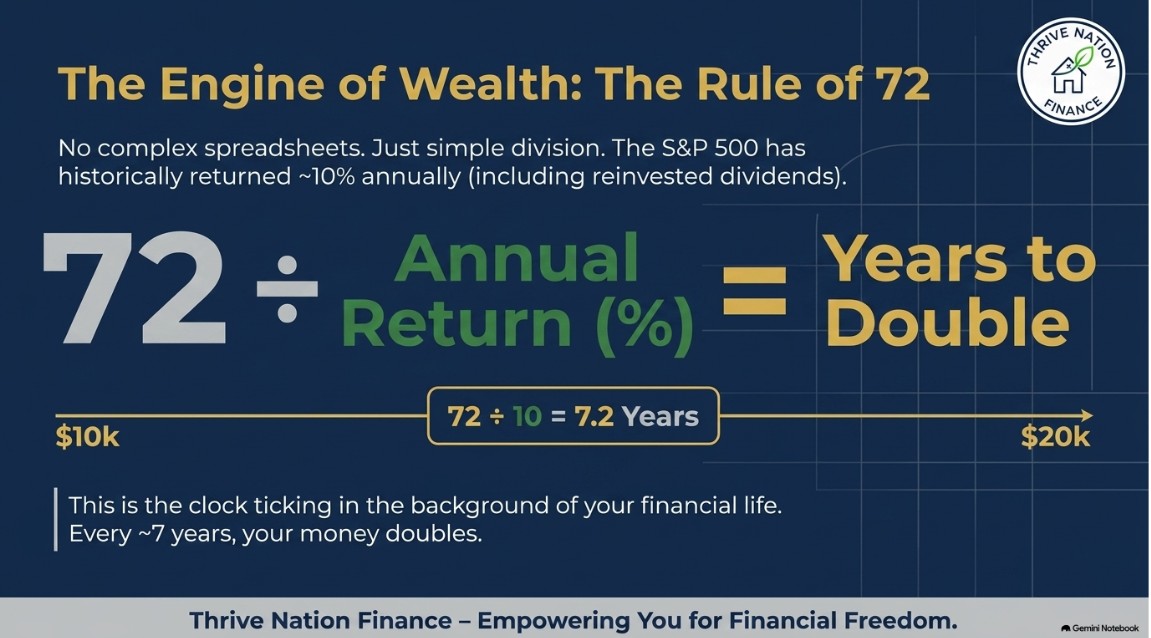
The Rule of 72 is a quick mental formula used to estimate how long it takes for an investment to double at a fixed annual rate of return. You simply divide 72 by the interest rate. For example, at 8% growth, money doubles in about 9 years (72 ÷ 8). It works because it approximates the effects of compound interest, and is most accurate for rates between 6% and 10%.
More Examples:
If your investments earn 10% per year on average:
72 divided by 10 = 7.2 years to double
If your investments earn 5% per year:
72 divided by 5 = 14.4 years to double
If your credit card charges 20% interest:
72 divided by 20 = 3.6 years to double your debt
This rule works because of compound interest, the same force that makes long-term investing so powerful.
How the Rule of 72 connects to compound interest
Compound interest means you earn returns not just on your original money, but also on the returns you've already earned.
Year 1: You earn interest on your principal.
Year 2: You earn interest on your principal plus Year 1's interest.
Year 3: You earn interest on your principal plus all previous interest.
Over time, this snowball effect accelerates. That's why Albert Einstein supposedly called compound interest the eighth wonder of the world.
The Rule of 72 is simply a shortcut to understand how fast that snowball grows.
At 10% returns, your money doubles about every 7 years.
At 5% returns, it doubles about every 14 years.
That difference may not sound huge, but over a lifetime, it's everything.
Two investors, same money, different starting ages
Let's make this personal.
Imagine two people:
Investor A starts at age 21, right after finishing school or arriving in Canada.
Investor B starts at age 35, after years of fear, uncertainty, or focusing on settling in.
Both invest in a broad index fund (like one that tracks the S&P 500 or a global stock index). Both start with $5,000 and add $6,000 per year (about $500 per month). Both earn an average of 10% per year over time.
Investor A: Starts at 21
By age 65, Investor A has contributed about $269,000 over 44 years.
Thanks to compounding at 10%, their portfolio grows to roughly $4.6 million.
That's more than 17 times their total contributions.
Investor B: Starts at 35
By age 65, Investor B has contributed about $185,000 over 30 years.
Their portfolio grows to roughly $1.17 million.
That's about 6 times their contributions.
The gap
Both earned the same 10% average return. Both used the same strategy. The only difference? Investor A started 14 years earlier.
That 14-year head start led to about $3.4 million more at retirement.
Why? Because Investor A's money had time to go through more doublings.
At 10%:
Investor A's money doubled roughly 6 times over 44 years.
Investor B's money doubled roughly 4 times over 30 years.
Each doubling builds on all the previous ones. That's the magic, and the math, of compounding.
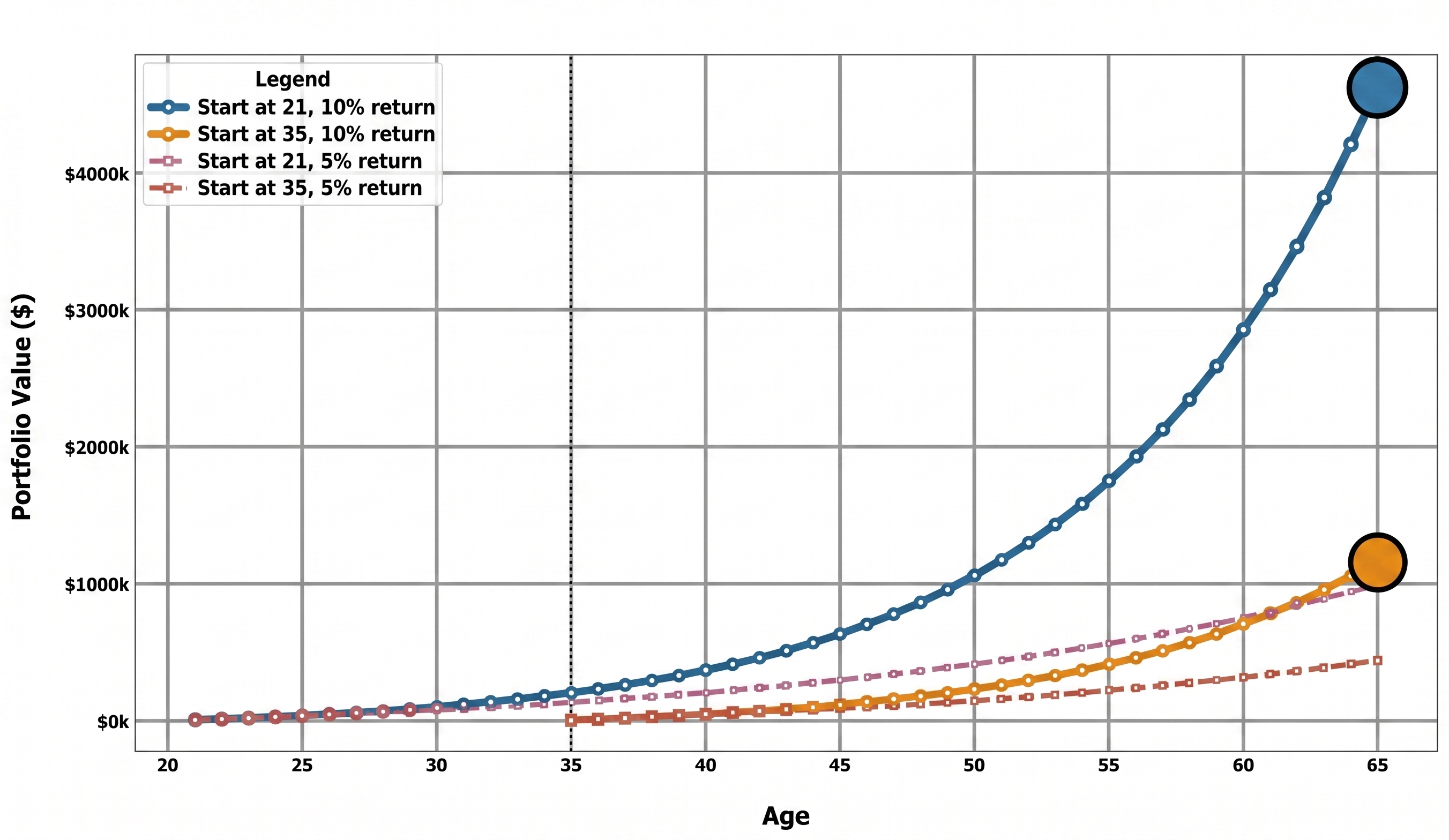
This graph shows four paths:
Starting at 21 with 10% returns (top blue line)
Starting at 35 with 10% returns (orange line)
Starting at 21 with 5% returns (dashed purple line)
Starting at 35 with 5% returns (dashed red line)
Notice how the 10% lines pull away dramatically over time. That's the Rule of 72 in action.
What if returns are lower, say 5%?
Not everyone is comfortable with 100% stocks. Some people prefer a more conservative mix, maybe closer to 5% average returns.
The Rule of 72 still applies:
72 divided by 5 = 14.4 years to double
Now look at the same two investors:
Investor A (starts at 21, 5% returns): Ends with about $995,000 at 65.
Investor B (starts at 35, 5% returns): Ends with about $440,000 at 65.
The gap is now about $555,000 instead of $3.4 million, but it's still massive.
The lesson isn't you must chase 10%. The lesson is:
Starting early matters more than chasing high returns.
Even at 5%, starting at 21 beats starting at 35 by a wide margin.
Time in the market is your biggest advantage.
The Rule of 72 works against you too: credit cards
Here's where this gets serious.
The Rule of 72 doesn't just apply to your investments. It also applies to your debt, especially high-interest debt like credit cards.
Imagine you have a $5,000 credit card balance at 20% APR, and you only make minimum payments or, in a worst-case scenario, no payments at all.
Using the Rule of 72:
72 divided by 20 = 3.6 years to double
That means:
In about 3.6 years, your $5,000 balance becomes $10,000.
In about 7.2 years, it becomes $20,000.
In 10 years, it could grow to over $30,000 if interest keeps compounding.
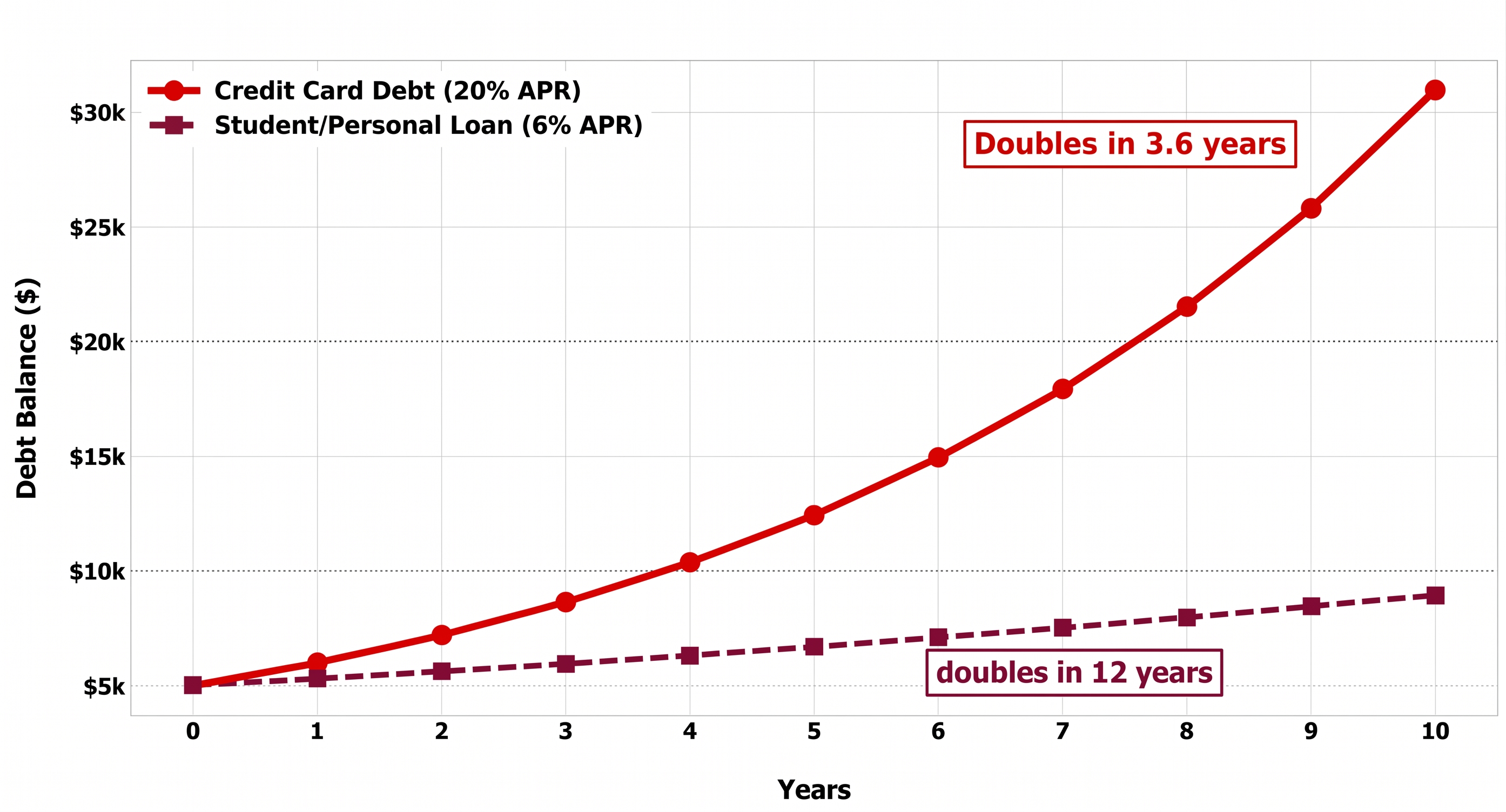
This graph shows how a $5,000 balance grows over 10 years at:
20% APR (credit card, red line)
6% APR (student or personal loan, purple dashed line)
At 20%, your debt doubles every 3.6 years. At 6%, it doubles every 12 years. That's why high-interest debt is so dangerous.
This is why financial advisors always say:
Pay off high-interest debt first.
A guaranteed 20% return from eliminating credit card interest beats most investments.
Every dollar you pay down is a dollar that stops compounding against you.
Dollar-cost averaging: your friend when you're scared
Many newcomers and immigrants tell me:
I don't know when to invest.
What if the market crashes right after I start?
I missed the early years. Is it too late?
This is where dollar-cost averaging comes in.
Dollar-cost averaging means you invest a fixed amount regularly, no matter what the market is doing. For example:
$500 per month into a broad index fund.
Every month, automatically, without trying to time the market.
When prices are high, your $500 buys fewer units.
When prices are low, your $500 buys more units.
Over time, you end up with a lower average cost per unit than if you tried to pick the perfect time to invest.
Combined with the Rule of 72, dollar-cost averaging gives you:
Consistency: You keep contributing through ups and downs.
Time: You stay invested long enough for compounding to work.
Peace of mind: You don't need to watch the news or guess market moves.
You're not trying to get rich quick. You're letting the math work in your favor over decades.
Why early investing is so powerful
Let's bring this back to the Rule of 72.
If you start at 21 and invest until 65, that's 44 years.
At 10% returns:
Your money doubles about every 7.2 years.
Over 44 years, that's roughly 6 doublings.
If you start with just $5,000 and never add another cent:
After 7.2 years: about $10,000
After 14.4 years: about $20,000
After 21.6 years: about $40,000
After 28.8 years: about $80,000
After 36 years: about $160,000
After 43.2 years: about $320,000
Now add regular contributions on top of that, and you can see how people end up with millions from relatively modest monthly investments.
If you start at 35, you still have 30 years until 65.
At 10%:
That's about 4 doublings.
Still powerful, but you've missed two full doublings compared to starting at 21.
This is why I always tell newcomers:
Start now, even if it's small.
Don't wait until you know more or have more.
Your future self will thank you for every year you start earlier.
Practical steps you can take this week
Here's how to use the Rule of 72 in your own life:
1. Estimate how fast your investments can double
Look at your expected average return.
For a diversified stock index fund, many long-term planners use 6 to 10% as a reasonable range.
Divide 72 by that number.
Examples:
6%: 72 divided by 6 = 12 years to double
8%: 72 divided by 8 = 9 years to double
10%: 72 divided by 10 = 7.2 years to double
Use this to set realistic expectations. Compounding is powerful, but it's not instant.
2. Check your debt
Look at your credit card APR.
Divide 72 by that rate.
If your credit card charges 19.99%:
72 divided by 19.99 = about 3.6 years to double
Ask yourself:
Do I want my debt to double every 3 to 4 years?
What could I do with that money if it were invested instead?
This mental shift often gives people the motivation to aggressively pay down high-interest debt.
3. Start small, but start
You don't need thousands to begin.
Open an account with a low-cost brokerage or robo-advisor.
Set up an automatic transfer, even if it's $100 or $200 per month.
Choose a broad index fund (total market, S&P 500, global equity).
Turn on dividend reinvestment.
Then:
Increase your contribution whenever you get a raise or new job.
Resist the urge to stop when the market drops. That's when your dollars buy more.
4. Think in doublings, not just dollar targets
Instead of saying I need $1 million, ask:
How many doublings do I have left?
If I have $50,000 now and earn 8%:
72 divided by 8 = 9 years per doubling
$50k to $100k to $200k to $400k to $800k
That's 4 doublings to get close to $1 million
This mindset helps you stay patient during the invisible years when growth feels slow.
For immigrants and newcomers: you're not behind
I hear this often:
I arrived in Canada at 30, 35, 40. I've missed the boat.
I spent my 20s studying, settling, supporting family back home.
I was too scared to invest. Now it feels too late.
Here's the truth:
You haven't missed the boat. You're just starting a different chapter.
The Rule of 72 still works for you.
Starting at 35 with discipline can still build serious wealth by 65.
Yes, starting at 21 is ideal. But starting at 35, 40, or even 50 is far better than never starting at all.
Every year you invest is another step toward:
More doublings.
More compounding.
More freedom in retirement.
The bottom line
The Rule of 72 is more than a math trick. It's a lens for seeing your financial future clearly.
It shows why early investing is so powerful.
It shows how compound interest builds wealth over decades.
It shows how credit card debt can destroy wealth just as fast.
It shows why dollar-cost averaging and staying invested matter more than timing the market.
You don't need to be a finance expert. You don't need to pick individual stocks. You don't need to watch the news every day.
You just need to:
Start as early as you can.
Invest regularly in broad, low-cost index funds.
Pay off high-interest debt aggressively.
Let time and compounding do the heavy lifting.
If you take one action today, let it be this:
Open an investment account.
Set up an automatic monthly contribution, even if it's small.
Choose a diversified index fund.
Then forget about it and let the Rule of 72 work for you.
Your future self will look back and thank you for the day you decided to start.
Want to go deeper?
If you found this helpful, you might enjoy:
My blog series on immigrant finance practical strategies for building wealth in Canada as a newcomer.
One-on-one coaching personalized guidance on investing, debt payoff, and retirement planning.
Subscribe to the Thrive Nation Finance newsletter to get new articles delivered to your inbox.
This article is for educational purposes only and is not financial advice. Always do your own research or consult a qualified advisor before making investment decisions.
About Thrive Nation Finance
Thrive Nation Finance is dedicated to helping immigrants and newcomers in Canada build wealth through financial literacy. We break down complex topics like investing, retirement planning, and debt management into simple, actionable steps you can start using today.
Follow us on Facebook. Connect on LinkedIn.