
Employment Insurance in Canada: The Complete Guide Every Worker Should Know
Employment Insurance (EI) is one of Canada's most important financial safety nets, yet it remains one of the most misunderstood government programs — especially for newcomers, self-employed entrepreneurs, and people juggling multiple jobs or work permits. This guide breaks down everything you need to know: what EI is, who qualifies, how much you can get, how long it lasts, what disqualifies you, and the special rules that apply to self-employed people, incorporated business owners, new parents, and temporary residents.
.png)
Employment Insurance in Canada: The Complete Guide Every Worker Should Know
Employment Insurance (EI) is one of Canada's most important financial safety nets, yet it remains one of the most misunderstood government programs; especially for newcomers, self-employed entrepreneurs, and people juggling multiple jobs or work permits. This guide breaks down everything you need to know: what EI is, who qualifies, how much you can get, how long it lasts, what disqualifies you, and the special rules that apply to self-employed people, incorporated business owners, new parents, and temporary residents.
What Is Employment Insurance?
Employment Insurance is a federal program that provides temporary income support to workers who lose their job through no fault of their own, or who need to step away from work for specific life events such as having a baby, recovering from illness, or caring for a critically ill family member. It is not a form of welfare or a handout funded by general tax dollars. EI operates like a mandatory insurance pool: workers and employers pay into it through payroll deductions, and the fund pays out to those who qualify when they need it.
The program is administered by Service Canada, with policy and rate-setting overseen by the Canada Employment Insurance Commission (CEIC).
Who Funds EI?
EI is funded almost entirely through payroll contributions from employees and employers, not general government revenue.
Employees pay a percentage of their insurable earnings. For 2026, that rate is 1.63%, applied up to the year's maximum insurable earnings (MIE) ceiling of $68,900. This caps an individual employee's maximum annual premium at $1,123.07.
Employers contribute 1.4 times whatever their employee pays for each worker, bringing their maximum contribution to $1,572.30 per employee in 2026. Employers deduct the employee's share directly from payroll and remit both portions to the Canada Revenue Agency (CRA).
Quebec workers pay a reduced rate (1.30% in 2026) because the province runs its own parallel Quebec Parental Insurance Plan, so Quebec residents don't pay into the federal maternity and parental EI stream.
All these premiums flow into a dedicated EI Operating Account within the federal government's Consolidated Revenue Fund. By law, the program is meant to be self-financing: the CEIC must set premium rates so that revenues and expenses balance out over a rolling seven-year period, rather than treating EI as an open-ended subsidy.
How the Annual Premium Rate Is Actually Set
Each year's rate isn't a political guess; it follows a legally mandated formula. Under Section 66(1) of the Employment Insurance Act, the government's Chief Actuary calculates a "seven-year forecast break-even rate": the premium level that would bring the EI Operating Account to zero by the end of a rolling seven-year window. The Commission then formally adopts this rate (it has legal discretion to differ, but usually follows the recommendation).
The calculation factors in the account's starting balance, projected expenditures over the next seven years, the total insurable earnings base across the workforce, and premium reductions granted to employers offering qualifying private disability plans or to provinces running parallel programs like Quebec's. To prevent shocks, the rate can only move by a maximum of 0.05 percentage points per year.
This is why EI premiums tend to shift gradually rather than jump dramatically, even during years when the fund's balance changes significantly.
What Counts as "Insurable Employment"?
Nearly everything discussed about EI eligibility traces back to a single legal concept: insurable employment. Under Section 5 of the Employment Insurance Act, insurable employment means work performed in Canada under any express or implied contract of service, whether written or oral, where you're paid by time, by the piece, or a combination of both. In plain terms, if you're a genuine employee doing work for someone else, your job is presumed insurable, regardless of whether you're salaried, hourly, or commission-based.
Certain job types are explicitly confirmed as insurable under the EI Regulations, including union members employed by their own union, apprentices and trainees, clergy members, barbers and hairdressers who don't own their shop, and taxi or commercial drivers who don't own more than half the vehicle or run the business themselves.
Several categories are explicitly excluded from insurable employment, no matter how the job is structured:
- Casual work performed for purposes outside the employer's regular trade or business
- Employment where a shareholder-employee controls more than 40% of a corporation's voting shares
- Employment by a provincial or foreign government
- Certain international exchange programs without genuine Canadian-based remuneration
- Employment where the employer and employee aren't dealing at arm's length, most commonly, family businesses
If it's ever unclear whether a job is insurable, either the employer or the worker can request a formal CPP/EI ruling from the CRA, which examines the actual working relationship (not just the contract wording) to determine insurability and how many insurable hours should be credited.
This distinction matters enormously because insurability determines three things at once: whether premiums are deducted, whether those premiums build toward EI eligibility, and how many insurable hours accumulate toward the thresholds discussed below.
Eligibility for Regular Benefits
To qualify for EI regular benefits, the standard job-loss benefit, you must demonstrate that you:
- Were employed in insurable employment
- Lost your job through no fault of your own (layoff, shortage of work, seasonal end, or being affected by flooding or wildfires)
- Have been without work and without pay for at least seven consecutive days in the last 52 weeks
- Worked the required number of insurable hours during your qualifying period (the last 52 weeks, or since your last claim, whichever is shorter)
- Are ready, willing, and capable of working each day
- Are actively searching for work and keeping a written record of your job-search efforts
You generally will not qualify if you were dismissed for misconduct, quit voluntarily without "just cause" (a specific legal standard, for example, unsafe working conditions or harassment), or are unemployed due to a labor dispute like a strike or lockout.
How Many Hours You Need
The hours required for regular benefits scale inversely with the unemployment rate in your specific EI economic region; the higher the local unemployment, the fewer hours you need:
Regional unemployment rate Hours required
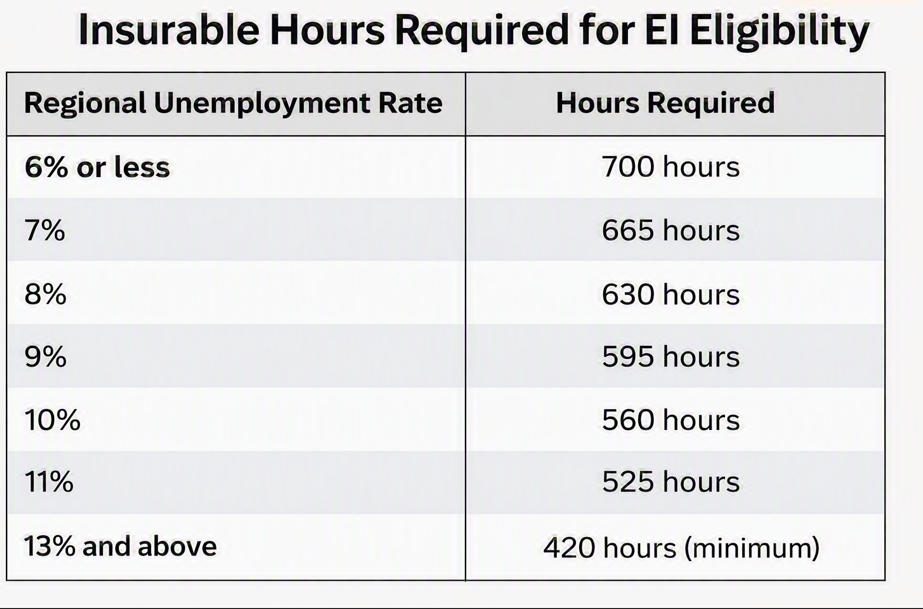
New entrants or re-entrants to the labor force; people who haven't worked much or at all in the past two years, need a higher 910-hour threshold regardless of local unemployment, since they lack a recent enough work history.
How Much You'll Receive
EI regular benefits pay 55% of your average insurable weekly earnings, calculated using your "best weeks" of pay within your qualifying period. The number of best weeks used ranges from 14 to 22, again depending on your region's unemployment rate, lower-unemployment regions use more weeks in the average, higher-unemployment regions use fewer.
As of January 1, 2026, the maximum insurable earnings amount is $68,900, capping the maximum weekly benefit at $729 per week. This ceiling applies no matter how much you actually earned; even someone who made $150,000 last year will have their benefit calculated using only the first $68,900 of income.
If your net family income is $25,921 or less and you have children receiving the Canada Child Benefit, you may qualify for a family supplement that raises your benefit rate, though total weekly payments still can't exceed the $729 cap.
If You Worked Multiple Jobs
Service Canada combines your insurable hours and earnings from every employer during your qualifying period into a single calculation, you don't get separate benefit amounts per job, and it doesn't matter which specific job you lost. Report every job on your application and request a Record of Employment from each employer, even if you're keeping one job and only lost the other.
One important nuance: your benefit is based on your highest-earning weeks, not a simple average of everything. If you only held two jobs simultaneously for a short window before losing one, that short overlap won't necessarily raise your average unless those weeks genuinely rank among your best-paid weeks across the full qualifying period.
If you lose one job but keep working another, you fall under the "Working While on Claim" rules: you keep 50 cents of your EI benefit for every dollar you continue earning, until your combined income (EI plus earnings) reaches 90% of your previous weekly earnings, after which EI reduces dollar-for-dollar.
Duration and Waiting Period
Regular benefits run for 14 to 45 weeks, depending on your region's unemployment rate and your accumulated insurable hours. If you combine regular benefits with special benefits like sickness or maternity in the same benefit period, the combined maximum is typically 50 weeks.
Special benefit durations vary by type:
- Maternity benefits: up to 15 weeks
- Parental benefits: 40 to 69 weeks, depending on the standard versus extended option
- Sickness benefits: up to 26 weeks
- Family caregiver benefits (child): up to 35 weeks
- Family caregiver benefits (adult): up to 15 weeks
- Compassionate care benefits: up to 26 weeks
Normally, there's a one-week unpaid waiting period before payments begin. However, a temporary federal measure currently waives this waiting period entirely for new claims established between March 30, 2025, and October 10, 2026, meaning payments can start immediately.
Claim Expiry and Renewal
Your EI "benefit period" — the window during which you're allowed to collect payments, generally lasts 52 weeks from the start of your claim, even if you haven't used all your entitled weeks within that time. If you don't file a claim within that window, or fail to reactivate an existing claim after returning to short-term work and being laid off again, access to your remaining weeks can lapse. Always apply as soon as you stop working, even before receiving your Record of Employment; delays can cost you benefit weeks.
Breaches, Disqualifications, and Misconduct
EI enforces strict compliance rules. Actions that can get a claim denied, suspended, or clawed back include:
- Misconduct dismissal; being fired for cause disqualifies you
- Voluntary quitting without just cause
- Quitting or being locked out during a labor dispute while it continues
- False statements or fraud; misreporting income, work search activity, or availability can lead to penalties, repayment demands, and disqualification from future claims
Special Temporary Measures: COVID-19 and Beyond
EI includes a legislative mechanism allowing the government to temporarily loosen its rules during national economic shocks, bypassing the normal thresholds without permanently rewriting the law.
During COVID-19, EI's standard system couldn't handle the volume of layoffs, so the government introduced the Canada Emergency Response Benefit (CERB); a flat $500-per-week payment available regardless of normal EI qualification. When CERB ended in September 2020, a simplified temporary EI system took over for one year, featuring a flat 120-hour minimum requirement (achieved by artificially treating every region as having a 13.1% unemployment rate), a one-time hours credit of 300 to 480 hours applied retroactively, a guaranteed minimum benefit rate, and a guaranteed minimum of 26 weeks of benefits. This expired in September 2021.
More recently, in response to economic disruption from tariffs, the government introduced temporary EI relief starting in spring 2025, extended through claims established by October 10, 2026. Three measures remain active:
- The one-week waiting period is waived
- Separation-payment rules are suspended, meaning claimants can collect EI immediately without first exhausting severance or vacation payouts
- Long-tenured workers; those who paid at least 30% of the maximum annual EI premium for at least seven of the last ten years and hadn't collected more than 36 weeks of benefits in the prior three years — can receive up to 20 additional weeks, for a maximum of 65 weeks total
Employment Insurance for Self-Employed Canadians
Self-employed individuals can access EI, but only for special benefits (maternity, parental, sickness, caregiving, compassionate care); never regular job-loss benefits and only after voluntarily opting in.
To register, you must be a Canadian citizen or permanent resident, own your business or control more than 40% of a corporation's voting shares, and register voluntarily through your My Service Canada Account.
The 12-Month Waiting Period
Once you register, your agreement with the Canada Employment Insurance Commission must stay active for at least 12 full months before you can submit any claim. Registration timing also affects your premiums: registering by April 30 bases your premiums on the previous year's tax return, while registering later uses the current year's return.
Earnings and Reduction-of-Work Requirements
To actually receive a payout, self-employed claimants must also show:
- Minimum net self-employment earnings of at least $9,254 in the prior calendar year (for 2026 claims; this threshold rises annually)
- A reduction in time devoted to the business by more than 40% for at least one week, due to a qualifying reason such as childbirth, adoption, illness, injury, or caregiving for a gravely ill family member
Premiums and Commitment
Self-employed participants pay the same employee premium rate as regular workers (1.63% in 2026, capped at $1,123.07 annually), with no employer-side match required since they're both worker and business owner. Importantly, once you make your first claim, you generally cannot withdraw from the program — you remain committed to paying premiums on self-employment income going forward. If you never claim, you can opt out at any time.
Sole Proprietors vs. Incorporated Owners
There's a meaningful legal distinction between these two structures, even though both are excluded from regular EI.
Sole proprietors are legally the same entity as their business, so there's no employer-employee relationship for EI purposes. They're automatically deemed uninsurable — no application needed — and pay no EI premiums on their business income by default. If premiums were mistakenly paid, a refund can be claimed for up to three prior tax years. Once a sole proprietor hires employees, they must deduct and remit EI premiums for those employees, even though they personally remain exempt.
Incorporated business owners technically can be "employees" of their own corporation, drawing a salary. But under Section 5(2)(b) of the EI Act, anyone who controls more than 40% of a corporation's voting shares is automatically excluded from insurable employment, no application or ruling required. The test is based specifically on voting shares, not total equity value, and the threshold is strictly "more than" 40%; someone holding exactly 40% remains insurable. Owners with 40% or less of voting shares could have genuinely insurable employment, but confirming this typically requires a formal CRA ruling.
How Incorporated Owners Still Access Special Benefits
Even though controlling shareholders are excluded from regular EI, they can voluntarily opt into the same self-employed EI program available to sole proprietors, following the same steps: registering through My Service Canada Account, committing to the 12-month waiting period, paying standard employee-rate premiums, and meeting the minimum earnings threshold. Once vested, they can access the same menu of special benefits as any other self-employed participant.
EI for New Parents: Maternity and Parental Benefits
Maternity Benefits
Maternity benefits are reserved exclusively for the person who is pregnant or has recently given birth; they cannot be shared with a partner. To qualify, you need 600 insured hours in your qualifying period and must show your regular weekly earnings dropped by more than 40% for at least one week.
Maternity benefits pay 55% of average insurable weekly earnings, up to the $729 weekly maximum, for a total of up to 15 weeks. You can start receiving benefits as early as 12 weeks before your due date, but you cannot receive maternity benefits later than 17 weeks after your due date or the actual birth date, whichever is later.
Apply as soon as you stop working, even before your Record of Employment arrives; waiting more than four weeks after your last day worked risks losing benefit weeks. Expect your first payment roughly 28 days after applying.
Parental Benefits
Parental benefits require the same 600-hour threshold as maternity, applied as a flat national standard regardless of regional unemployment rates (unlike regular benefits). Importantly, the same 600 hours that qualify a birth parent for maternity benefits also cover parental eligibility on the same claim; it isn't a separate, additional requirement.
Each parent who wants to claim parental benefits must independently meet the 600-hour threshold on their own work record and submit their own separate application. Hours cannot be pooled or transferred between parents. If only one parent has accumulated 600 hours, only that parent can claim, regardless of how the household wants to divide leave.
What can be shared between parents is the pool of benefit weeks, not the hours requirement itself:
- Standard option: up to 40 weeks total shareable, with no single parent taking more than 35 weeks
- Extended option: up to 69 weeks total shareable, with no single parent taking more than 61 weeks
- Both parents must choose the same option — standard or extended cannot be mixed
Are EI Maternity and Parental Benefits Taxable?
Yes. EI benefits are fully taxable income. Service Canada withholds federal and provincial tax at source before depositing your payment, and the gross taxable amount appears on a T4E slip (Statement of Employment Insurance and Other Benefits) that must be included when filing your tax return.
One important catch: tax withholding on EI payments is calculated based only on your EI income, ignoring any salary you earned earlier in the year before your leave began. This often results in under-withholding once your full annual income is combined, leaving many recipients with an unexpected tax bill or a smaller refund the following spring. Recipients can proactively request additional voluntary tax withholding from each payment to avoid this surprise.
The good news: EI has a benefit repayment rule (sometimes called the clawback) requiring higher earners who collected regular benefits to repay a portion if their net income exceeds a set threshold ($86,125 for 2026). Maternity, parental, sickness, compassionate care, and family caregiver benefits are explicitly exempt from this repayment provision, regardless of income level.
EI and Immigration Status: Work Permits, Temporary Residents, and Students
EI eligibility does not depend on citizenship or permanent residency. As long as your job counted as insurable employment, meaning your employer deducted EI premiums, you accumulate the same entitlement as a citizen or permanent resident.
The catch is availability: to collect EI, you must remain legally authorized to work in Canada throughout your claim. If your work permit expires without a timely extension application on file, you lose the ability to prove you're available for work, and Service Canada will end your claim.
Open work permit holders generally have an easier path, since they can legally work for any employer while job-searching, satisfying the availability requirement without complication.
Closed or employer-specific permit holders face more scrutiny, since their permit only authorizes work for one named employer, which can create questions about whether they're genuinely available for the broader labor market.
Temporary foreign workers have explicit government confirmation that they may qualify for EI if they lose their job through no fault of their own, or if they leave due to abuse or mistreatment by their employer.
International students can access EI if they meet the insurable hours threshold, but often struggle to prove they're "ready, willing, and available" for full-time work given their primary obligation to school.
Protecting Your Claim When Your Permit Is About to Expire
If you apply to extend or change your work permit before it expires, you automatically receive maintained status (formerly "implied status"), which lets you keep working under your original permit's conditions while the application processes and this satisfies EI's availability requirement without interruption. Apply at least 30 days before your expiry date as a safety buffer. If you miss this window, an expired-permit disentitlement can effectively end your claim, and those lost weeks typically cannot be recovered later.
Post-Graduation Work Permits
Since a PGWP is an open work permit, holders generally have a smoother path to EI than closed-permit workers. However, a PGWP is fixed-length and cannot be renewed or extended once it expires, that's final. If your PGWP is set to expire while collecting EI, you can receive benefits right up until the expiry date, but your claim ends at that point unless you've secured a different type of valid status beforehand.
Bringing It All Together
Employment Insurance is built around a few core ideas that explain nearly every rule discussed above: coverage depends on insurable employment, eligibility depends on accumulated hours (which vary by benefit type and sometimes by region), benefit amounts are capped by the year's maximum insurable earnings, and access can be affected by your employment structure (employee, self-employed, or incorporated owner) or your immigration status.
For newcomers building a life and career in Canada, understanding these mechanics isn't just bureaucratic trivia; it's a genuine financial planning tool. Knowing how many hours you need before a life event, understanding that your work permit status directly affects your EI availability, and recognizing that incorporating a business doesn't automatically protect your income the way it protects your liability can all shape real decisions about timing, structure, and preparation.
EI won't replace full income, and it has real limits and exclusions. But used correctly and planned for in advance, it remains one of the most valuable safety nets available to workers in Canada; provided you understand exactly how it works before you need it.